PRESS RELEASE
PKPA & DINAS SOSIAL NISEL
LAKSANAKAN WORKSHOP PENGHAPUSAN PEKERJA ANAK
Mengusung tema “ Menuju Nias Selatan Bebas Pekerja Anak” PKPA bekerjasasama dengan Dinas Sosial Pemerintah Kabupaten Nias Selatan dan didukung oleh Kindernothilfe menyelenggarakan workshop evaluasi kebijakan dan pengembangan program aksi penghapusan bentuk-bentuk pekerjaan terburuk untuk anak di Nias Selatan. Workshop selama 2 hari pada tanggal 10-11 Mei 2011 bertempat di Rei Center, Teluk Dalam.Bertindak sebagai fasilitator kegiatan Sdr. Misran Lubis (Direktur Eksternal PKPA).
Bupati Nias Selatan yang diwakili Plt. Kepala Dinas Sosial Nias Selatan Bapak. Tandramböwö Lase membuka secara resmi workshop ini. Dalam sambutannya Plt. Kepala Dinas Sosial mengatakan persoalan anak di Nias Selatan sangat kompleks, selain masalah bentuk-bentuk pekerjaan terburuk masih ada persoalan-persoalan lain yang belum teratasi dengan baik. Seperti masalah perdagangan anak baik anak laki-laki maupun anak perempuan, perkosaan anak-anak, penganiayaan dan anak terlantar. Lebih lanjut Bapak Tandramböwö Lase mengatakan rasa terima kasih kepada PKPA karena secara terus menerus memberikan perhatian kepada anak-anak di Nias Selatan.
Workshop dihadiri 30 peserta anggota Komite Aksi Kabupaten Nias Selatan untuk Penghapusan Bentuk-bentuk Pekerjaan Terburuk bagi Anak (KAK-PBPA NISEL) yang berasal dari berbagai lembaga pemerintah, organisasi keagamaan, organisasi kemasyarakatan dan perguruan tinggi. Selama dua hari melakukan diskusi dan evaluasi terhadap situasi pekerja anak di Nias Selatan, para peserta memberikan sejumlah rekomendasi untuk ditindak lanjuti oleh Pemerintah dan seluruh elemen masyarakat di Nias Selatan. Beberapa rekomendasi tersebut antara lain:
- Komite Aksi Kabupaten Nias Selatan untuk Penghapusan Bentuk-bentuk Pekerjaan Terburuk bagi Anak (KAK-PBPTA Nisel) yang telah di bentuk melalui SK Bupati Nisel sejak Mei 2010 harus segera menyusun program kerja dan alokasi anggara di masing-masing SKPD untuk mengatasi masalah anak di Nias Selatan.
- Pemerintah Kabupaten Nias Selatan segera membuat peraturan untuk menetapkan bentuk-bentuk Pekerjaan Terburuk yang dilarang untuk anak-anak di Nias Selatan dan mensosialisasikannya kepada masyarakat luas.
- Penyediaan infrastruktur layanan bagi anak yang menjadi korban kekerasan, seksual dan penelantaran.
Diakhir acara semua peserta menyatakan dukungan dan komitmennya untuk mengawal agar rekomendasi yang akan disampaikan kepada pimpinan-pimpinan pemerintahan di Kabupaten Nias Selatan benar-benar terealisasi. (Mis/PKPA 11-Mei-2011).
Stop Buruh Anak
Kamis, Mei 12, 2011
Jumat, Mei 06, 2011
PKPA TERBITKAN DUA MODUL BENCANA BERPERSPEKTIF ANAK
Tsunami dan gempa bumi yang terjadi pada 26 Desember 2004 yang melanda Propinsi Aceh dan Sumatera Utara, Indonesia memberikan pengalaman tersendiri bagi PKPA dalam melaksanakan program kemanusiaan yang secara spesifik ditujukan pada perlindungan anak di situasi yang tanggap darurat. Setelah gempa bumi dan tsunami yang maha dahsyat terjadi di Aceh dan Sumatera Utara, bencana alam susulan terjadi di beberapa tempat lain di Indonesia. Salah satunya adalah gempa bumi berkekuatan 8,7 SR meluluh lantakkan bumi Nias, kemudian letusan Gunung Merapi dan gempa bumi di Yogyakarta dan Jawa Tengah tahun 2006, dan rentetan bencana lainnya di Indonesia. Potensi bencana di Indonesia tergolong sangat tinggi, menurut catatan Badan Kordinasi Nasional Penanggulangan Bencana dan Pengungsi (BAKORNAS PBP) selama kurun waktu 1997-2004 tercatat lebih dari 1000 kali bencana di Indonesia. Dengan tingkat korban jiwa diperkirakan lebih dari 40.000 Jiwa. Belum termasuk data bencana Tsunami yang terjadi di Aceh dan Sumatera Utara tahun 2004, dimana korban jiwa lebih dari 200.000 orang dan di pulau Nias korban jiwa mencapai 800 orang.
Tragedi kemanusiaan selalu menyisakan duka dan kerugian yang tidak terhitung, namun kita selalu mengambil hikmah dari setiap peristiwa tersebut sebagai pelajaran berharga dari alam. Salah satu pembelajaran yang dapat diambil dari setiap bencana yang terjadi di Indonesia adalah bahwa anak-anak merupakan kelompok yang sering terabaikan dan tidak tertangani dengan baik. Trauma psikologis, kesehatan anak dan perlindungan khusus terhadap anak, kurang mendapat perhatian dan sering tidak tepat dalam penanganannya. Kondisi lain yang juga mengancam anak-anak dalam situasi darurat pasca bencana adalah eksploitasi ekonomi, keterpisahan dari keluarga dan kehilangan arena dimana mereka biasa beraktifitas dan bermain dengan teman-teman sebaya. Anak-anak dalam keadaan darurat/bencana bisa berada dibawah risiko dan ancaman serius, karena tingkat ketergantungan mereka yang tinggi terhadap orang dewasa. Mereka belum memiliki banyak pengalaman hidup, kemampuan anak untuk melindungi diri sendiri terbatas, dan mereka tidak dalam posisi yang dapat mengambil keputusan atas dirinya sendiri.
Melihat kenyataan yang terjadi selama ini telah mendorong keprihatinan tersendiri bagi PKPA sebagai sebuah lembaga yang konsern pada anak-anak, merasa penting untuk menciptakan sebuah pedoman bagi para relawan kemanusiaan dalam penanganan anak-anak korban bencana. Meski panduan ini bersifat internal untuk pedoman relawan PKPA, namun tidak tertutup kemungkinan lembaga-lembaga lain yang membutuhkan dapat memanfaatkannya dengan terus berlatih dan belajar dari setiap peristiwa.
Setelah bekerja selama enam bulan sejak Juni hingga akhir Desember 2010 akhirnya PKPA bisa menyelesaikan penulisan dua modul yang terkait dengan kebencanaan dengan konten utama untuk menyelamatkan dan memperkuat partisipasi anak. proses penulisan kedua modul tersebut telah melalui sebuah penelitian mendalam di Sumatera Utara, Aceh dan Sumatera Barat melibatkan berbagai informan dari berbagai sumber mulai dari instansi pemerintah, Internastional NGOs, Nasional NGO, Local NGO, Akademisi, Tokoh Masyarakat, Guru dan Anak-anak. Meski PKPA sendiri telah memiliki sejumlah data dan pengalaman langsung dari penanganan anak dalam situasi tanggap darurat, namun proses kajian mendalam dianggap penting untuk pengayaan data, informasi dan pengalaman banyak pihak. kedua modul tersebut adalah:
1. Modul Pendidikan Pengurangan Risiko Bencana Bagi Sekolah; Pentingnya Modul ini didasari dari kenyataan bahwa, dari beberapa institusi yang ada di komunitas masyarakat, sekolah merupakan salah satu institusi strategis untuk diperhatikan terkait pengurangan risiko bencana. Ada beberapa alasan untuk ini; Pertama, sekolah tempat komunitas anak yang terorganisir dalam jumlah besar, sehingga anak-anak memiliki kerentanan menjadi korban bencana terutama jika pada saat kejadian mereka sedang berada di ruang kelas. Kedua, sekolah memiliki potensi mentransformasi pengetahuan, nilai dan tradisi pengurangan risiko bencana secara terencana, sistimatis dan berkelanjutan. Pendidikan pengurangan bencana bagi sekolah (PRB-BS) dapat dilaksanakan melalui berbagai pendekatan, baik Pendidikan formal, nonformal, maupun informal.
2. Modul: Pedoman Penanganan Anak dalam Situasi Tanggap Darurat; Tingginya potensi bencana di Indonesia, namun Indonesia belum memiliki sistem penanganan bencana yang komprehensif untuk melindungi anak-anak. Indonesia seharusnya memiliki sebuah kebijakan khusus untuk menangani anak-anak dalam situasi tanggal darurat. Institusi-institusi lokal yang ada di komunitas seperti sekolah, panti-panti asuhan, organisasi keagamaan, lembaga adat/budaya perlu diperkuat kapasitasnya untuk mampu memberikan respon cepat menangani anak-anak ketika bencana terjadi. Institusi-institusi ini sangar dekat dengan kehidupan anak-anak, agar penanganan anak-anak tidak mengalami keterlambatan karena harus menunggu kehadiran organisasi-organisasi perlindungan anak dari luar daerah maupun luar negeri. Hal ini seharusnya dapat mengurangi kondisi lebih buruk yang mengancam anak dalam situasi tanggap darurat. Dengan adanya pedoman ini diharapkan dapat menjadi salah satu revensi bagi para relawan kemanusiaan dan orang-orang yang terdekat dengan anak saat bencana dating, untuk menentukan sikap dan langkah-langkah yang tepat menangani anak.
Semoga kehadiran kedua modul ini di Indonesia akan menambah referensi dan pengetahuan baru bagi semua pihak dalam meningkatkan perhatian dan partisipasi anak dalam penanggulangan bencana di Indonesia. Bagi anda yang ingin memiliki kedua modul tersebut dapat mengirimkan surat ke alamat kantor PKPA Medan Jln. Abdul Hakim No.5A Pasar I Setia Budi, Medan, 20132 atau kirim via email ke pkpamdn@indosat.net.id atau lubiscom@yahoo.com. PKPA juga dapat memfasilitasi anda sebuah training untuk meningkatkan kemampuan tim anda menggunakan kedua modul tersebut. Kontak Person: Misran Lubis (Kordinator Unit PKPA Emergency Aid).
Salam Penulis
Misran Lubis
Senin, Mei 02, 2011
PROTECTING CHILDREN IN EMERGENCY SITUATION
(PKPA’s experiences in emergency response program in Indonesia)
By: Misran Lubis (Coordinator of PKPA Emergency Aid)
Disaster situation in Indonesia
The 26 December 2004 earthquake and tsunami that struck Aceh and North Sumatra Provinces, Indonesia, gave PKPA valuable experiences in humanitarian program with specific objective to protect children in emergency situation. The deadly earthquake and tsunami in Aceh and North Sumatra Provinces were also followed by a series of natural disasters in other areas in the country such as the 8.7 on the Richter scale earthquake that rocked Nias in 2005, Mount Merapi eruption and strong earthquake that hit Yogyakarta and Central Java in 2006, etc. It is a fact that Indonesia is particularly vulnerable to natural disaster. Based on data from the National Coordinating Agency for Disaster and Refugee Management (Badan Koordinasi Nasional Penanggulangan Bencana dan Pengungsi – BAKORNAS-PBP), there were more than 1,000 disasters in Indonesia from 1997 to 2004. These disasters killed approximately 40,000 people. This still excluded more than 200,000 people who were killed by the 2004 earthquake and tsunami in Aceh and North Sumatra and more than 800 people who were killed by the strong earthquake in Nias Island.
The high intensity of earthquake in these last five years clearly shows that Indonesia is one of disaster prone countries in the world. Indonesia is particularly vulnerable to not only tectonic earthquake but also volcanic earthquake. This is because the country is located on the ring of fire. Climate change also may cause natural disaster in Indonesia. Nearly 80 percent of areas in Indonesia are at high risk of natural disaster such as earthquake, tsunami and volcanic eruption.
Earthquake, tsunami and volcanic eruption prone areas in Indonesia
Based on disaster map in Indonesia, it is only some areas in Kalimantan Island which are not categorized as earthquake and tsunami prone area. Currently, Indonesia has more than 129 active volcanoes and more than 500 inactive volcanoes. These volcanoes are spread in some areas in Sumatra Island, Java Island and Sulawesi Island. These last 100 years, there are more than 175,000 people who were killed by volcanic eruption.
One of lessons learned from any disaster in Indonesia is that the needs of the affected children are often overlooked and they are not protected properly. Trauma and illness due to the disaster are often overlooked and not dealt with properly. Additionally, children in emergency or disaster situation are particularly vulnerable to economic exploitation, separation from family and loss of playground where children can play with their peer. Condition of the refugee camp which is not child-friendly is often deteriorated by child abuse and exploitation.
Due to their dependency on adults, children in emergency or disaster situation are at high risks and under serious threats. Since children are still immature, they have no capacity to protect themselves and are not in a position to make a decision that may affect their lives.
Following the 2004 earthquake and tsunami in Aceh and Nias, child survivors are not safe from various threats automatically. Hundreds of children are kidnapped and trafficked due to separation from family and acute poverty following the disaster. Hundreds of children in Nias Island also have to work as construction worker and in sand mining to meet the need of building materials for rehabilitation and reconstruction works. Following the strong earthquakes in Yogyakarta and West Sumatra, the affected children are forced to become beggar along the street.
Although Indonesia is a disaster prone country, it does not have any comprehensive disaster management system to better protect children. In its disaster management scheme, the Indonesian Government still does not pay special attention to child protection aspect. Even, the protection and fulfillment of the fundamental rights of the affected community, including those of the affected children, are merely seen as moral and social issue rather than State’s responsibility and duty to its people.
PKPA and humanitarian mission for children
The condition of children so far has raised great concern to PKPA as an organization which focuses its program mainly on child issues in Indonesia. PKPA has started its emergency response and humanitarian mission program since 2003. In the year, flash floods swept Bukit Lawang of North Sumatra and killed more than 200 people. In 2004 and 2005, PKPA implemented emergency response program to assist those affected by the earthquake and tsunami in Aceh and Nias Island. In 2006, PKPA also implemented emergency response program following the strong earthquake that struck Klaten, Central Java. In 2009, the organization worked with victims of West Sumatra earthquake. Meanwhile, in 2010, PKPA implemented emergency response program for victims of Mount Sinabung eruption in the District of Karo, North Sumatra.
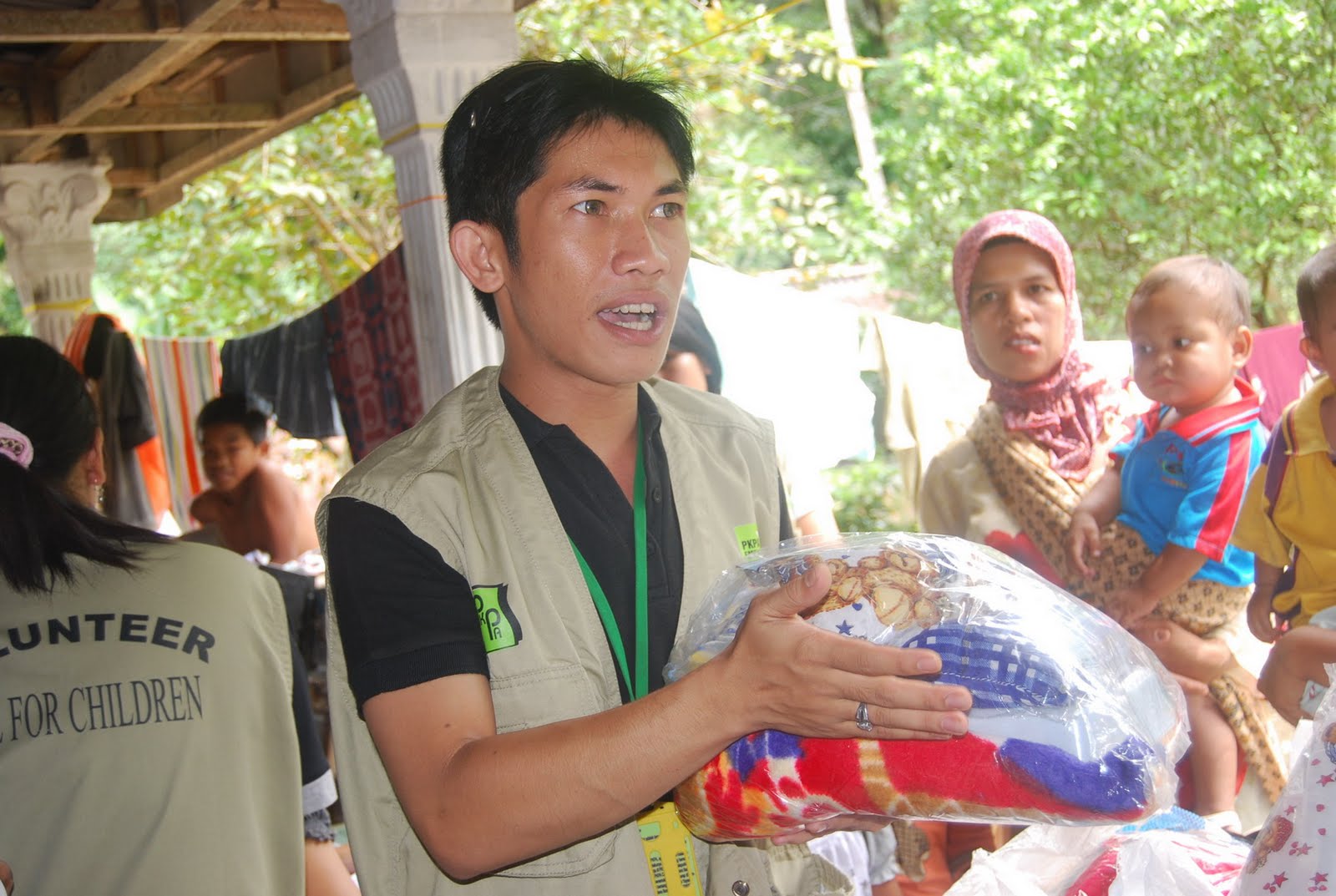
Up to now, PKPA has been working with more than 25,000 child IDPs through its humanitarian relief program such as a) Child trauma and psychological recovery, b) Provision of temporary school service and school recovery program, c) Provision of micro nutrient and basic health service for women and children, d) Child protection and advocacy for the fulfillment of children’s fundamental rights in refugee camps, and e) Provision of school-based and child-based disaster preparedness.
PKPA also has established a special service unit called PKPA Emergency Aid (PEA) to pay greater attention to children in emergency or disaster situation.
The establishment of this special service unit by Center for Study and Child Protection (Pusat Kajian dan Perlindungan Anak – PKPA) in 2006 is an integral part of its strategic plan to prevent possible worst things that may happen to children in emergency situation. The establishment of the special service unit is encouraged by the fact that children’s fundamental rights are often violated in disaster situation in Indonesia, especially in North Sumatra, Nias Island and Aceh. The establishment of PKPA Emergency Aid aims:
a) To develop mechanism, system, work structure and service prioritized for children affected by disaster and conflict
b) To prepare child-friendly volunteers and humanitarian relief organizations in emergency situation
c) To give support and humanitarian response to children in areas affected by disaster and conflict in Indonesia
d) To take child-friendly disaster risk reduction efforts
PKPA Emergency Aid develops two modules
Following the completion of its emergency response program in West Sumatra in 2009, PKPA received supports from two international organizations i.e. World Vision International (WVI) and Kindernothilfe (KNH) Germany to develop two disaster-related modules. The first module is ‘School-based Disaster Risk Reduction Education’ which is supported by WVI and the second module is ‘Protection and Dealing with Children in Emergency Situation’ which is funded by KNH. The two modules will complete the existing modules in Indonesia.
Following are reasons for the development of these two child-based and school-based modules:
Children are the most vulnerable group in disaster situation (the number of children who are killed by natural disasters in Indonesia is very high).
Children spend about 30 percent of their time in school (organized child community).
Disaster risk reduction is an integral part of the national education system.
It is particularly important to improve child participation in any policy related to children, especially in disaster issues.
School is often used as shelter or refugee camps during disaster or emergency situation.
The development of the modules is based on not only academic theory but also field studies, local wisdom in Indonesia and experiences of field staffs and volunteers in emergency response program. The development of module entitled ‘School-based Disaster Risk Reduction’ is based on modules and approaches so far used by WVI and the implementing partner. It is expected that the module will offer a more applicable and contextual method to its users during disaster risk reduction together with children and school community in Indonesia. Meanwhile, KNH also hopes that the module can be adopted and used by its partners in other countries, especially those affected by disaster like Indonesia.
Supports for disaster preparedness and emergency response
Since Indonesia is a disaster prone country, disaster preparedness is vital to enable relevant parties to give quick response to the situation of children. Below are the needs of PKPA Emergency Aid for disaster preparedness:
a. Evacuation tool: Currently, PKPA has two ambulances. However, the organization still needs operational costs for fuel, drivers, volunteer team and health workers in emergency situation.
b. Special tent for children: two units of 6 x 8 meter tents with good ventilation. The special tent for children should be equipped with blanket, bed, mattress and pillow.
c. Mobile library car: It will be used for learning and recreational activities to ensure that the psychosocial activity can reach all IDP camps.
d. Funds: The funds will be used to meet children’s basic needs such as nutritious foods, medicines and daily clothes.
If you want to support PKPA’s humanitarian program in emergency situation in Indonesia and disaster risk reduction education, please contact:
PKPA Medan
Jl. Abdul Hakim No. 5 A Pasar I, Setia Budi, Medan, Indonesia, 20132
Phone: +6261- 820 0170 Fax : +6261-821 3009
Email: pkpamdn@indosat.net.id & lubiscom@yahoo.com
Website: www.pkpa-indonesia.org or www.niaschild.multiply.com
Contact Person: Ahmad Sofian (Executive Director)
Bank details:
Bank name: BNI Cabang Medan,
Account number: 0057863176, account holder: Yayasan PKPA
Langganan:
Postingan (Atom)